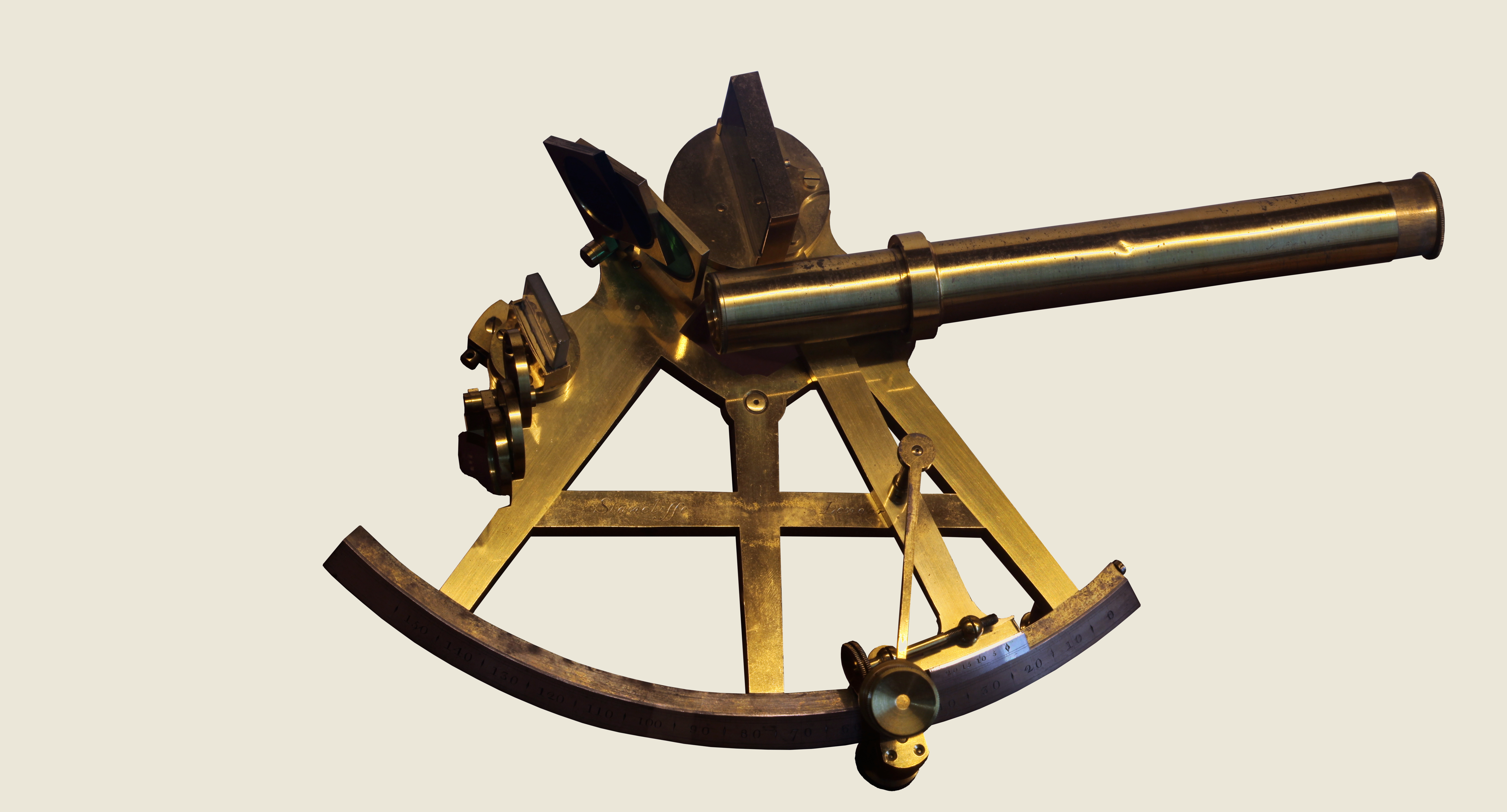
The instrument
The sextant is a navigational instrument built for one purpose: to measure the angle between a celestial body and the horizon. Its arc spans sixty degrees, one-sixth of a circle, which is where the name comes from.
By the late eighteenth century it was standard equipment on any vessel making long passages. With a sextant, a chronometer, and astronomical tables, a navigator could fix the ship’s position anywhere on the globe.
Sailors learned to use it cold, in moving seas, often before dawn or after dusk. The work demanded patience, and that patience was preparation. The sextant was built for a single moment, and the navigator had to be ready to meet it.
The meridian passage
Every celestial body traces a daily arc across the sky. Once a day, that arc crosses the observer’s meridian — the imaginary line running from one horizon to the other, through the zenith directly overhead. At that crossing, the body reaches the highest point it will climb.
That moment is the meridian passage — the body’s peak transit. For a navigator, it’s the easiest and most precise observation available: hold the sextant steady, follow the body as it climbs, and the instant the angle stops increasing is the moment to read. From that single measurement, with no clock or complicated calculation, the navigator fixes the latitude.
A single careful observation. Taken at the right moment. Tells you exactly where you stand.
Resonance
GPS has made celestial navigation obsolete in any practical sense, but the practice was never just about the technology. It was about a posture toward the work.
Investing rewards the same posture. Patient observation. Careful measurement. The willingness to wait for the right moment. Practiced long enough, these habits build wealth.
That is this firm’s work: knowing exactly where you are — what you own, what you owe, where you’re headed, and what is actually possible.
That is Meridian Passage.
Start a conversation
Schedule a call